A feast for hunters

paj

As autumn is moving in we thought that we needed to connect with all our friends that has seen us out and about reenacting hunters. We also wanted to show people how easy it can be to gather in medieval a setting, and at the same time encourage those that has not been into reenacting in this way before to join up.

Of course, we also wanted to show some part of the medieval hunt, and also educate our fellows around this subject. The choice soon fell upon ‘The gathering’. This is the place where the hunters gather and wait for all the preparatory work before the actual chase. The great hunt, the hunt that was mostly praised and the hunt most huntbooks are concerned about, was a big affair.  Many people and dogs where involved. It was usually prepared the day before, if not several days ahead.

In the books we see this gathering as a feast, and this is also how it is described:

Edward of Norwich, master of game

[…]And also they that come from home should bring thither all that they need, every one in his office, well and plenteously, and should lay broad clothes all about upon the green grass, and set divers meats upon a great platters after the lord’s power.

c38_616

In the pictures it sure looks as described.

And some should eat sitting, and some standing, and some leaning upon their elbows, some should drink, some laugh, some jangle, some joke and some play — in short do all manner of disports of gladness […]

Now, this was what we wanted!
People eating and drinking and having fun!

We decided to make the learning part of the event as a game. A three part game where two parts are team based and the last one was individual within the winning team.

The feast begineth!

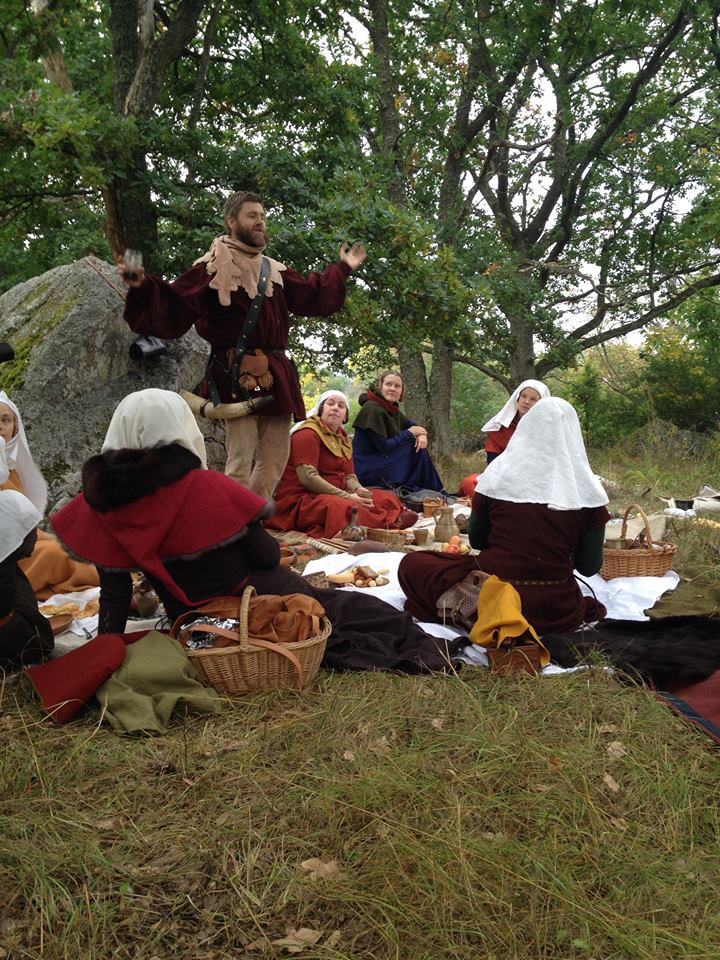
As we gathered all the participants took their roles seriously, broadcloth was layed out, spreadsome ate standing, some sitting and some on their elbows. armbågarEven laughing was done. There was some games going on in the background as we waited for all to gather. The always playful Alex had a whole bag of more or less demeaning games to throw upon us. One of these where ‘The three blind beggars and the pig’ – originally played with three blind beggars and a pig of course. The winners price was traditionally to get the pig for him/her self. Even during medieval times this game was played with people just miming the roles.

When all had gathered and had gotten something to eat to still their hunger, we decided it was time to start the games.
diciplar

Announcing the beginning of the huntgames

The first game!

The first game is closely connected to the gathering. If we look at the picture above.. there is one detail that most overlook, but is actually the most important part of the picture. And that, is this man at the high table, presenting some brown balls to the huntsmaster.

poopshowingWhat he is doing is presenting the fumes, or poop, of the animal he has found. Judging by the shape and size, the huntsmaster will, with the help of a description of the track, decide the size, and gender of the animal. He will also see how much ‘grease’ the animal have. A animal in high grease was preferred because it was believed to be a sign of god health.

If you look closely at these pictures in the future, you will notice that this happen is all these picknick pictures. The presenting of the fumes was crucial for the hunt.

Jägarna rastarNamnlösThe hunter was instructed to carry the fumes in his horn. Properly stuffed with grass to prevent them from falling out. In the picture above, from Les livres du roi Modus et de la reine Ratio, you can see the hunter pouring them from his horn. On the other, From Livre de chasse, you can see how it smudges the tablecloth.

Boldly we set the hunters loose in five teams and soon they where off into the woods and fields to seek out fumes from prey. We had no idea at all if they would find anything, if they would be gone for the rest of the evening or if they would return in ten minutes, frowning at us for making them collect poo at their feast.

bajsök

Looking into ditches and field for that just perfect winning poo…..
poophunt

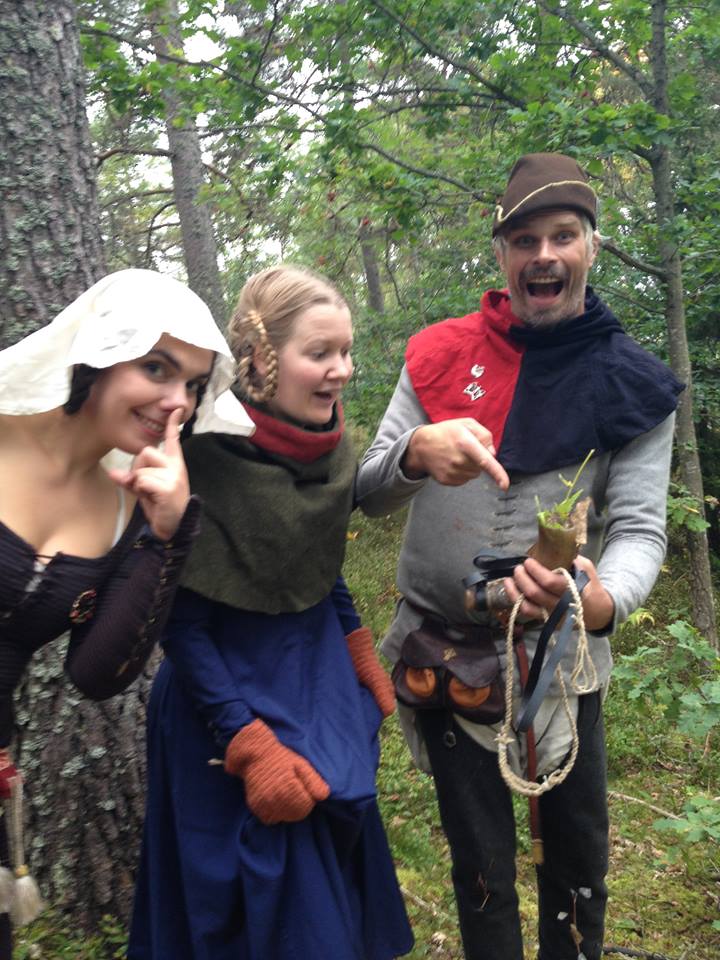
Happy hunters with a horn stuffed with grass.

As the hunters started to filter back, they all looked perfectly happy and eager. Most could scarcely wait for all teams to come in before showing their little treasures to us. As soon as all the teams had found their way back, the judging could commence. We had, at the start, no idea what we would consider ‘good fumes’, and was prepared to go with “sometimes no poop is the best poop”. The judging was therefore completely arbitrary.

In the end, we judged the only fresh fumes we got as the winner. As this being the one most likely still around and possible to get hold of. That the animal in question was a sheep, we did not take into consideration…

The winner of this contest got a nice little golden stick, one that they had use for in….

The second game!

Part two was a rather non medieval walk-quiz (tipspromenad) with questions from the huntbooks. The questions had three alternative answers, so there was a one in three chance to get them right.fråga We had chosen the more funny parts of the books as a base for the questions to give our participants a feel for how hilarious these books can be. To see the questions, in Swedish, you can go to our FB album. To answer the questions, we had made a very… medieval looking answering-board, where you put a stick in the hole that you thought corresponded with the right answer. 20140919_145223The winning team had their golden plug, a token that would give them one automatic right answer on a question. But obviously this was to complicated a task to understand since they just left it on the side instead of using it on a question. Thus thinking it would just magically turn one of their wrong answers to a right one, and we let them have it their way. fråga två
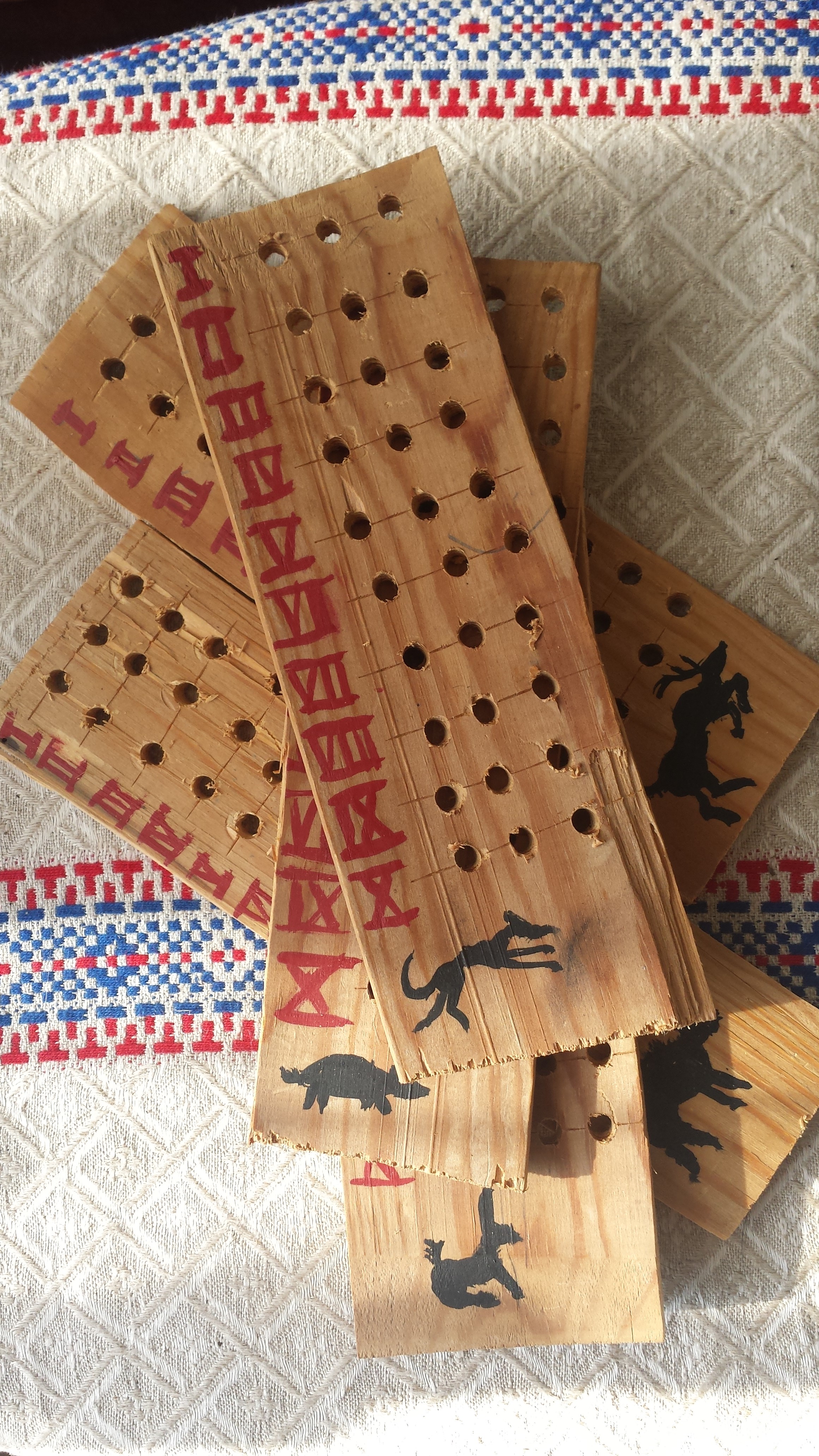
The second game resulted in a tie, prompting us to come up with a tiebreaker. In true 14:th century style we let the two teams have a debate on the subject ‘Why do we hunt?’. Both teams came up with a similar explanation, stating mankind’s dominion over beasts, one team quoting the bible and the other the Greek philosopher Aristotele who was in high regard during the Middle ages. As both teams core argument was so much alike, we deemed the team relying on Aristotele the winner because of their skilled use of classic rethorics.

The third game!

The third game was to establish who really was the greatest hunter. So the winning team now had to compete amongst themselves to establish one winner.
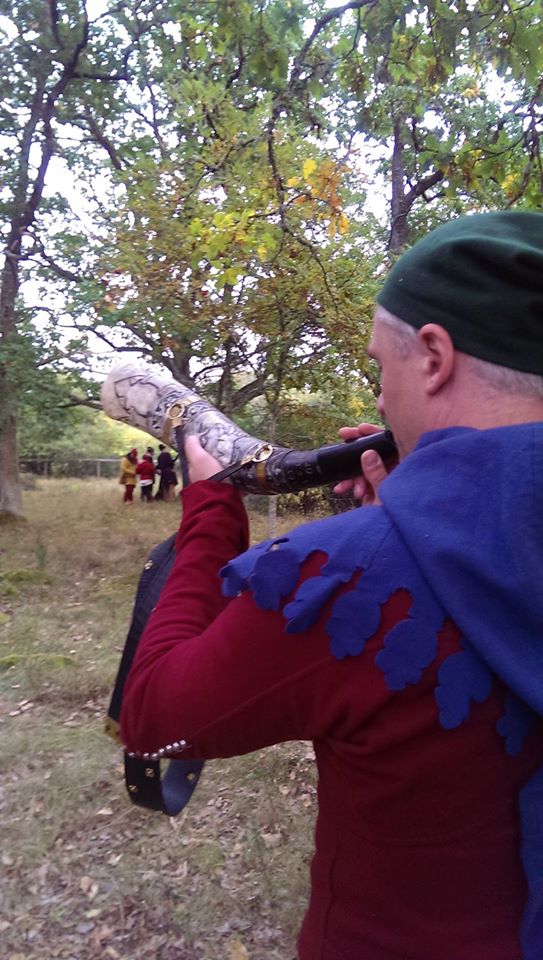
magnus horn

Magnus trying the horn after the competition

The contest was to blow a signal on the hunters horn. We choose one of the simplest signals, “The game is afoot”, blown when the game has been moved by the lymer and is up and running. This is for the rest of the hunters, the start of the chase. They all had to use the same horn, mine, and no one got to practice before. We showed them how the signal was to be blown… and let them loose. Most could not get a sound more then some wet farting, and few could get a note that was clear. Then stepped up, Martin, a member of St Huberts Rangers. He instantly blew a clear shrill note that made our bones shiver and  the crows shriek back. Clearly this was our winner!

The prize was athe hat nifty hat that Emil had made based on the one seen in the good rule. We where in good luck as it fit well on Martins somewhat big head.

 And the feast goes on

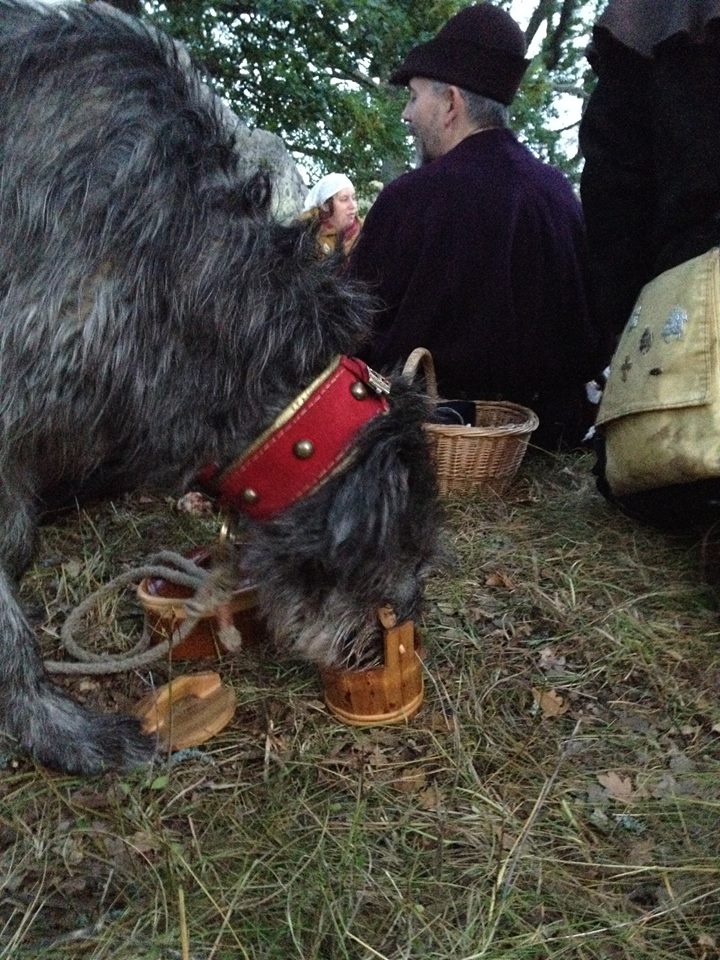
As the excitement of the games was reined in, people simmered down and had a joyful time once again. the somewhere around 30 participants dug into the food once more. Forgetting blissfully that those fingers just had been handling excrements of all kinds of dubious animals.more eating As the evening closed in, the dogs started to take advantage of peoples slackening attention. This was something that was most certainly an issue during the medieval times on these gatherings. So for me this was a good part of the event, the participants needed to keep their food safe from the dogs. Because dogs was a really big part of the hunt ( I hope for more dogs to participate next time) foodstealing dogs add to the reality of the event., mattjyvsomething Boudica was very much aware of and made the most of. I think her tally was half a meat, a small pie, some cheese, and this… that might have been some cheesecake.
As evening turned into night the failing light eventually made us pack up and go home. It was a successful event, all those that partook seems to have enjoyed themselves. Hopefully they learned something, if nothing else they learned about new people.

It was also a good event in time, as not much happens at the reenacting-scene in autumn. We like to keep active the year around, so spreading out events is a good thing. The scope of the event, in its pick-nick form was good, since it made the work less for the arrangers. Everyone brings their own things, just like the huntbooks advices.

So, until next time, get out and have your own hunters gatherings!

skål

/Johan

As usual, you can see more pictures at our FB album

Using the hunters horn.

The sound of the horns and the barking of the dogs, the excitement of that experience, is often described as the most joyful thing in hunting. 1176193_10152147330522926_384463484_n

Communication with the other hunters is most important use of the hunters horn. In the medieval huntbooks different signals are described that should be sounded in different phases of the hunt. You blow a certain signal when you are going out on a hunt and another when you are riding back home. There is a signal for when the game is sighted or the hounds are to be released or to call them back and finally after a kill you blow the “mort”.

What not everybody knows is that the horn also plays an important role before the hunt, used in a way that may seem strange to us today. The huntbooks describe how some hunters are sent out in advance to track up animals and suggest appropriate game.

NamnlösThey return to the merry gathering of the hunters and report their findings to the Master of the Hunt, informing him about where the animals are, what their tracks look like and bring back fumes for him to judge them by.

When found, the fumes are stuffed into the hunters horn and he seals it with some grass to keep the fumes from falling out.

Here the hunters are seen pouring “fumes” out of their hunting horns. Judging by the shape, size and quality of the fumes from different animals, the master of Hunt decides for the most appropriate game.

10385300_10152160196587765_5947767721368674630_n

Hunter pouring fumes out of his horn.

Edward of Norwich teaches us in his book Master of Hunt from early 15th century, how a to know a Great Hart by the Fumes:

“I shall teach you to know a great hart by the fumes of the hart, for sometimes they crotey in wreaths, sometimes flat and sometimes formed. Sometimes sharp at both ends and sometimes pressed together.

If he find the fumes that are formed and not holding together as it is from the beginning of July into the end of August, if they are great and black and long and are not sharp at the ends, and are heavy and dry without slime, it is a token that it is a hart chaceable.

If the fumes are faint and light and full of slime, or sharp at both ends, or at one end, these are the tokens that he is no deer chaceable. If they be slimy it is a token that he has suffered some disease.”

Edward elaborates quite a bit on the subject of fumes so I took the liberty of shortening his advice slightly. Read more about our hunting horns and how Edward of Norwich thinks they should be made here. Johan is as always one step ahead and provides an informative video about the use of the hunters horn.

/ Emil

Making a hunters horn.

Rolands horn

Rolands horn Olifant as seen in Santiago de Compostella

How should a hunters horn look like?  A great hunters horn was traditionally made in ivory, carved decoratively and they are called “olifant’s”, just like Rolands horn Olifant in La Chanson de Roland.

In the late Norse 13th century Karlamagnussaga it is said that Olifant actually was the horn of a unicorn.

If you’d like to see it, you can either visit the famous pilgrim site of Santiago de Compostella in Spain or the Vitus cathedral in Prague who both claim to be in possession of it.

Namnlös

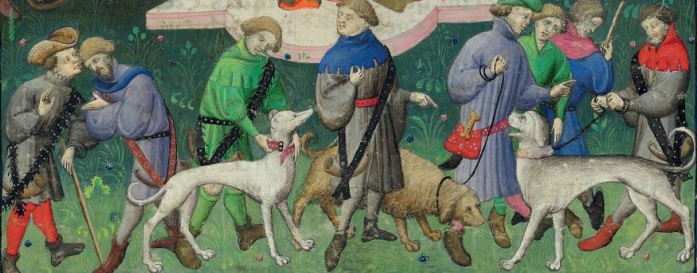
Hunters with their hunting horns in wide baldrics. Livre de chasse 1407.

My horn is not ivory, nor is it from a unicorn. But it is sort of monumental, none the less. 10635871_10152625159850708_1425179991131912415_n

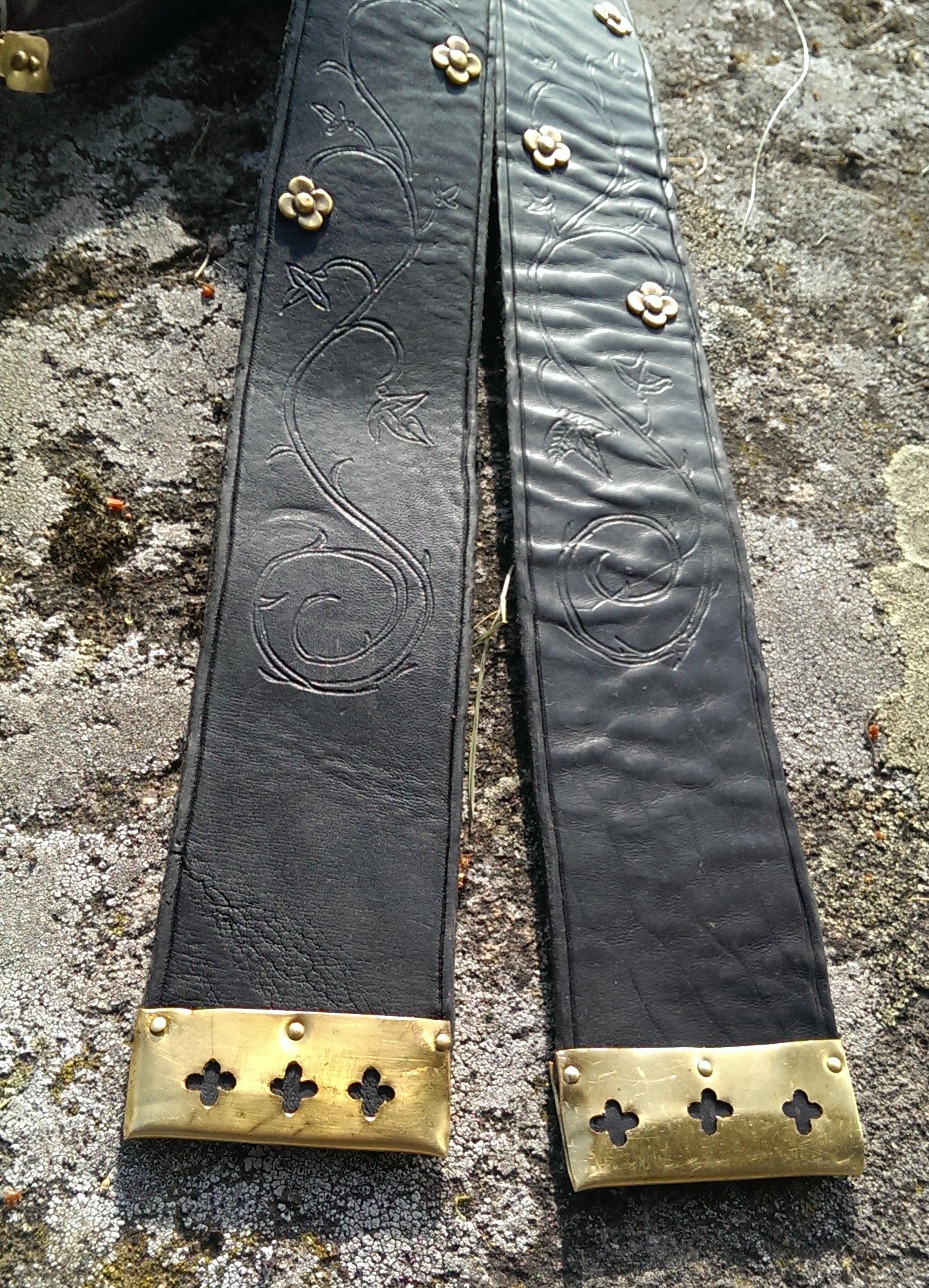
Johan has carved it beautifully for me and today I finished a new pompous baldric in the style of Livre de chasse. A baldric is the sholder strap in which the horn is carried.

The baldrics in Livre de chasse are often very wide, mostly of a straight cut but sometimes dagged in the edges (as seen above). Both coloured and undyed baldrics appear. Typical for this manuscript is that they often are decorated with what looks like little round-ish metal mounts.

I choose to interpret them as little brass flowers on my baldric. Then I filled up the space between the mounts with a floral pattern inspired by what I’ve seen in period illuminations, picking up the shape of the leafs that Johan carved in to my horn. I’m happy with how it turned out, especially the brass fittings I’ve made myself, stepping slightly outside my comfort zone as a craftsman.

IMAG2450

IMAG2457IMAG2452


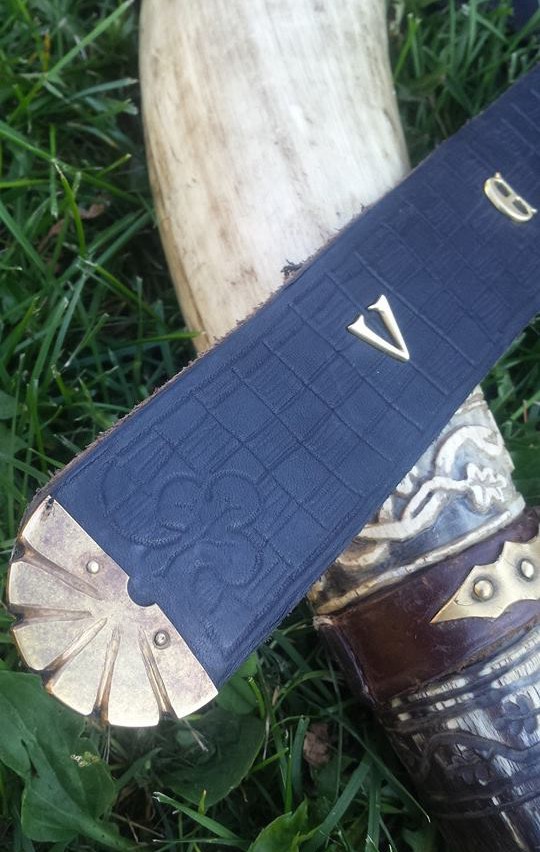
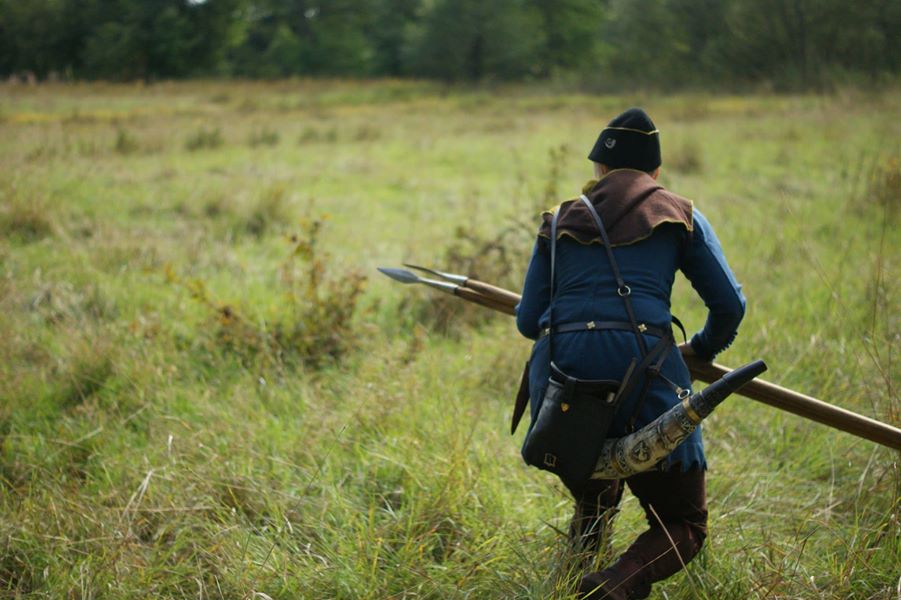
Johan made his own horn over 10 years ago and has been wearing it on events in Sweden and around Europe since then. IMAG2398The age and patina adds to its beauty, but his baldric is new. The brass letters on it says “venator”, meaning hunter, and “veltrahus” is one in charge of greyhounds.10430477_819255604786371_4273931695073881414_n

10505376_832170526828212_8484417598505684701_n


10603563_832170480161550_3325916715314553240_n


Edward of Norwich teaches us about hunting horns in his book Master of Hunt from early 15th century:

“There are diverse kinds of horns, that is to say bugles, great Abbots, hunters horns, ruets (trumpets) and meaner horns of two kinds. That one kind is waxed waxed with green wax and greater of sound, and they be best for good hunters, therefore I will devise how and in what fashion they should be driven.

First a good hunters horn should be driven of two spans in length, and not much more nor much less, and not too crooked neither too straight, but that the flute be three or four fingers upper more than the head, that unlearned hunters call the great end of the horn.

And also that it be as great and hollow driven as it can for the length, and and that it be shorter on the side of the baldric than at the nether end. And that the head be as wide as it can be, and always driven smaller and smaller to the flue, and that it be well waxed thicker or thinner according as the hunter thinks that it will sound will sound best.

 And that it be the length of the horn from the flute to the binding, and also that it be not too small driven from the binding to the flute, for if it be the horn will be too mean of sound. As for feweterers and woodsmen, I speak not for every small horn and other mean horn unwaxed be good enough for them.”

I’ve also written a short article about the medieval hunters use of his or her horn. Johan is as always one step ahead and provides an informative video.

/ Emil


Yngve trötts huntingcompetition

emil smyger In concert with Söderköpings Gästabud there is a very popular contest being held.
This is the ‘Yngve Trötts Bågskyttetävling” (Yngve The Tireds archer-competition). This year it had opened up to all medieval projectiles (maybe it was before, but this year it was pronounced). The competition is in the form of a hunt-trail. It is therefore, to my knowledge the only big event actually doing ‘medieval hunting’ in Sweden. It is a very popular competition, having 60 participators from the whole of Europe. Some even travelled here from Iceland, and it usually takes a lot to lure the Icelanders of their island.

So, me and Emil, of course, had no other choice but to pack our javelins and sally forth to glory and odd animal-hunting!

We travelled light, only carrying what was needed and hoping to get covered by our friends tents in case of rain. The Town of Söderköping is very old, the street of Vintervadsgatan having had the same stretch for 1000 years. It was once a centre of commerce in the area of Östergötland (Eastgothia).

lejongrupp

Our six man group: Annie, Suleyman, Johan, Martin, Miriam and Emil. Boudica is photobombing, as usual.

But, back to the event.
The hunt-trail consisted of 22 targets in rather steep terrain. We went out around 10 in the morning and was not back until 5 hours later. We where divided into groups of about 5 or 6. Me and Emil was the only ones not using a bow. We didn’t really have any expectations of getting any points that would put us in the upper field of the points-roosters as the course was set for bows and not javelins. But we did get the permission to go closer if needed when the distance was to long. At each target you fired two missiles. If you hit it with the first one, you got ten points. If you missed and hit it with the second, five. So you could get ten, five or zero points on each target (some had special rules…).

The weapons had to be medieval in both design and making and so was the archers clothes and other gear (or.. in many cases.. medieval-ish) .

20140830_125750[1]

Annie searching for misplaced arrows

The missiles had to stick to the target, they where not to fall off OR to go straight through. Other than that, it was just hit or miss that counted. Where you hit it was of no interest. After that, came the searching of arrows….

Out on the trail!

wpid-wp-1409668860960.jpeg

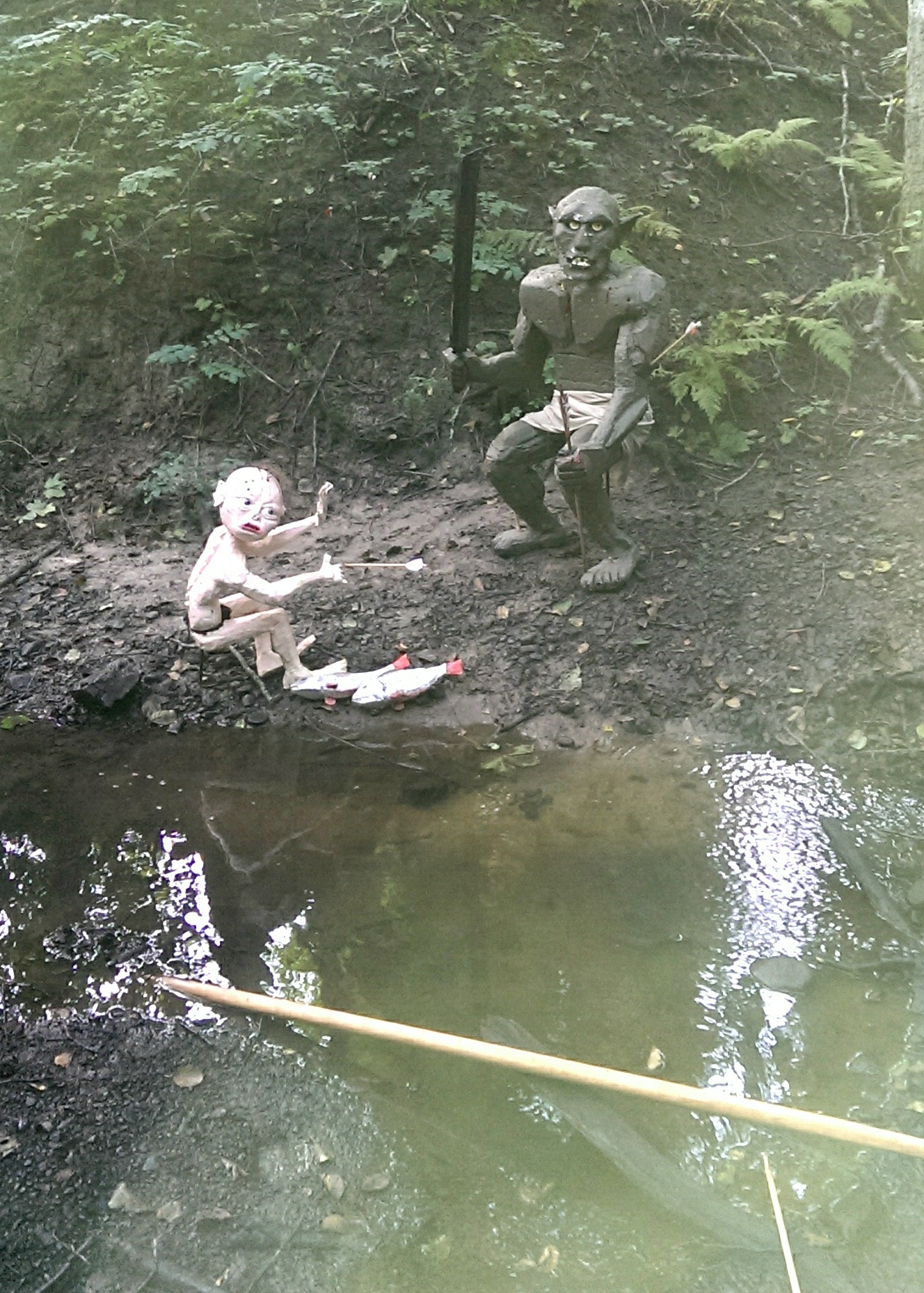
Gollum, his fishes and an orc stealing them! Emils spear in the stream missed the party.

During the years this competition have had some different themes. This was reflected by the plethora of diverse targets we encountered out on the trail. There where some regular boring animals, like badgers and boars, 20140830_131640 but also Drollerie animals in the style of the Lutrellpsalter and good old favourites like the killer rabbit from Monty Python and Lord of the Rings characters.

Our apprehension about the distance to the targets where soon abated. The targets where often well inside javelin-distance, and especially if you got to move a bit so you got the steadier footing needed to throw. We did not move more then absolutely necessary to be able to throw though. Making the long distances for the archers, very long distances for javelins. But sometimes we had to cut the distance in half just to have a  chance to be able to throw at all. Some, like a shot over the canal, was not even to think about. But in general, I think that the targets were well placed and that we had a decent chance to partake with our javelins. Some targets where even easier with javelin than bow, so I guess it kinda evened out a bit.

gående

On the trail (Photo by Annie Rosén)

We mostly throw javelin in the best conditions. Level ground, we choose the distance, the target is not obscured. Throwing it in the field is something else. The ground was never even, it was always uphill or downhill. Sometimes even so steep you where throwing from above the targets. The footing was perilous and there where seldom room to throw with the whole body. It was a very good experience, and very educating. I found myself over and over thinking “what did I just do? That’s not how you throw a javelin”. And then I did it again… and again. One might say I was a bit off my game and one might be right. That I had just re-shafted the spears and not had time to practise with them before I started might also count into the mix… But these are excuses, the sad truth is that I SHOULD have hit several more targets then I did. I just wasn’t good enough. Most throws went low and short. Probably I tried to throw AT the target when I had to adjust for distance and aim ABOVE. This is something I learned for one thing. I also learned that bows are vastly superior as hunt-weapons compared to javelins, and this helped me to convince me that my theory about its uses holds water, so far.

The targets
tailhit

Miriam with a good tailhit on one of the drolleritargets (Photo by Annie Rosén)

The targets where handmade from the same things floaters for swimming pools are made of (like poolnoodles and their flat compadres of the water) and then coated and painted. They where very good and sturdy for targets. The range was, as said before very imaginative and fun to see, giving the whole event a loose and fun atmosphere.

At the end of the competition there is traditionally a target for long distance shooting (100 meters =109 yards). Evidently there used to be a mounted knight as target, but since no one managed to hit that, they choose to have a live size elephant this year..  (that they did hit).  But as 98 meters is the current world record for javelins, we didn’t think it worth to partake on that target…

After the competitions the elephant was taken into the camp and had, of course, its trunk 20140831_121841_Richtone(HDR)turned into a beer hose. Just like they would have done in 14:the cent.

Our thoughts about the event

wpid-wp-1409669883441.jpeg

Fieldrabbittarget. All rabbits that fell down counted for 5 points. But if you hit Gerorge the ermine, you got zero.

We think it was a very well run event. Even if we, lazy buggers that we are, had not given much effort to gather information, we easily got in on everything and got all the information we needed, when we needed it. Its not easy to have 60 people running around in the woods shooting at stuff, but the group system (that built on trust, as each group counted their own points) worked very well. Clumping together of groups is usual in these things, but it rarely happened once the filed was getting spread out over the trail. The targets was smart, fun and well placed. The difficulty seemed well-balanced and the special targets (moving ones, special rules ones and so on) added spice so it did not get repetitive.

The organisers was very friendly and welcoming. You really felt that they where glad to have you there, this also set an atmosphere of fun and of not taking things to seriously, witch is always refreshing in competitive events.

And how did it go?
The best got 220 points. I got 45.

/ Johan

Something more about Javelins?
see our little film.

The Manuscript Challenge: A boar hunters outfit.

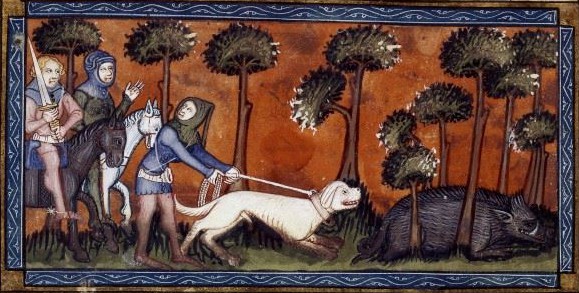
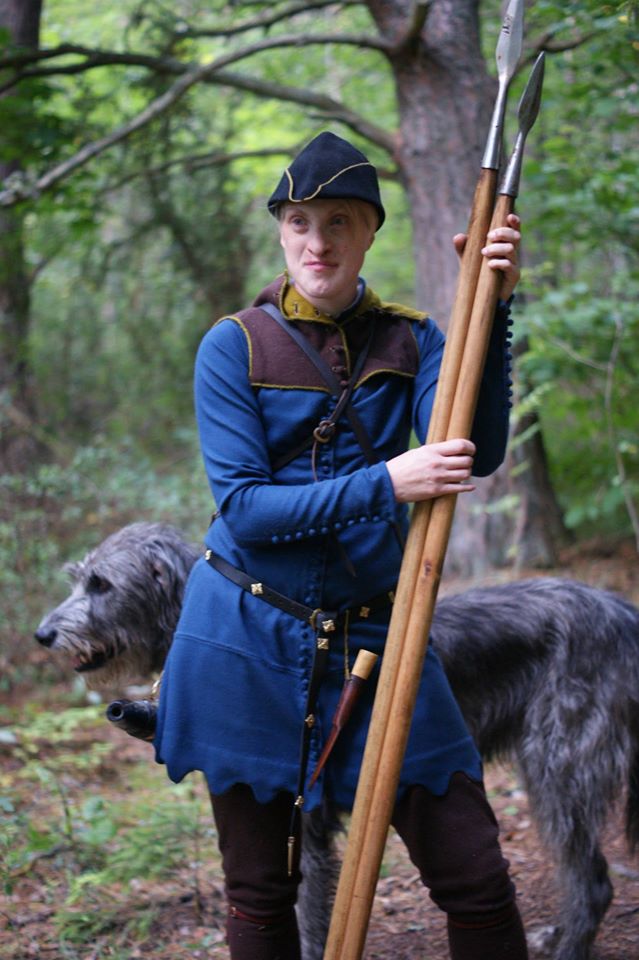
This post is about the making of my new outfit, my answer to The Manuscript Challenge. I’ve done an interpretation of the dog-handler in a boar hunting scene from “Les livres du roi Modus et de la reine Ratio”, the King Modus manuscript from ca 1370.

I admit that this outfit is well within my comfort zone and not very different from what I already have in terms of gear. But I like how it looks, it fills a gap in my wardrobe and I thought that it could be fun to interpret something exactly from a picture in my favourite medieval hunting book. In this way I can be sure that what I’m wearing are things that are meant to go together and hopefully well suitable for the activity depicted.

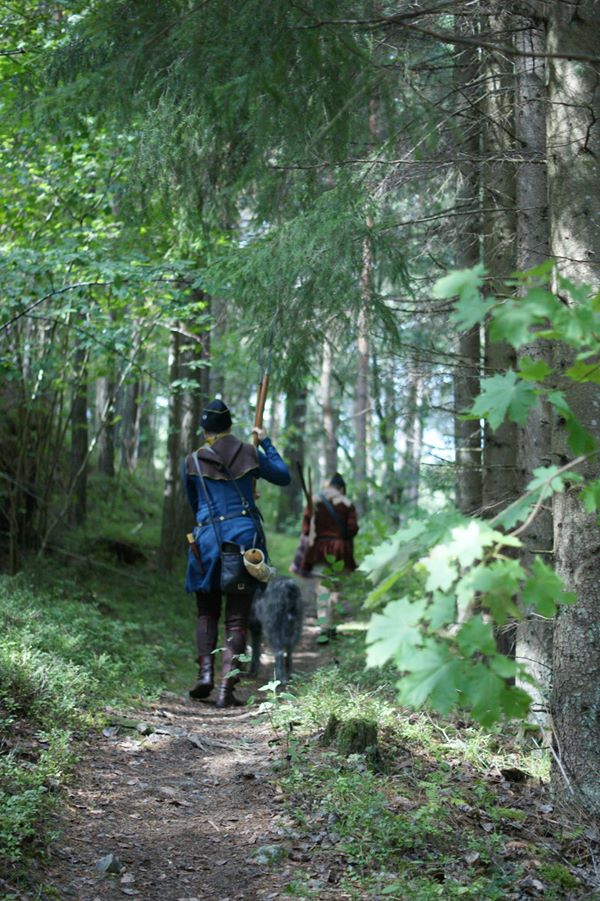
1797515_10152160197582765_4688588845508775182_nAs you can see, this hunter is wearing a tight liripipe hood (the making of it is described in detail here) and matching hoses with fashionably pointy toes. Like many hunters on foot during this period, he is not wearing any shoes. That might lead us to suspect the hoses being soled with leather. Tiny stripes on the horn suggest that it could be carved decoratively and the thin baldric is crossed below the waist. He is also wearing a thin black belt.

The hunters blue kirtle is very well fitted and buttons down the front, probably also on the sleeves. It has a generous cut over the chest to achieve the masculine Gothic ideal, a muscular “dove-chest” contrasting the narrow waist and straight fit over the hips. The kirtle on my manuscript picture reaches to mid thigh where it ends with a softly dagged edge.

IMAG2007

To short and to tight!

I made the pattern myself, fitting my toille in front of the mirror. Being a bit to eager to get started, I made two stupid mistakes. Firstly, I didn’t take any pictures of this step of the making. Secondly, when I had stitched the kirtle together and dagged the bottom edge, all by hand, I realised that I had cut it to short and a bit to tight to begin with. I looked stupid with my breeches (linnen underwear) showing to much and it would be hard to do any hunting with dignity in such a tight kirtle. (Admittedly, I have no ambitions of really doing any real hunting or anything requiring dignity at all. But I’d prefer if it didn’t show to much. 😉 )

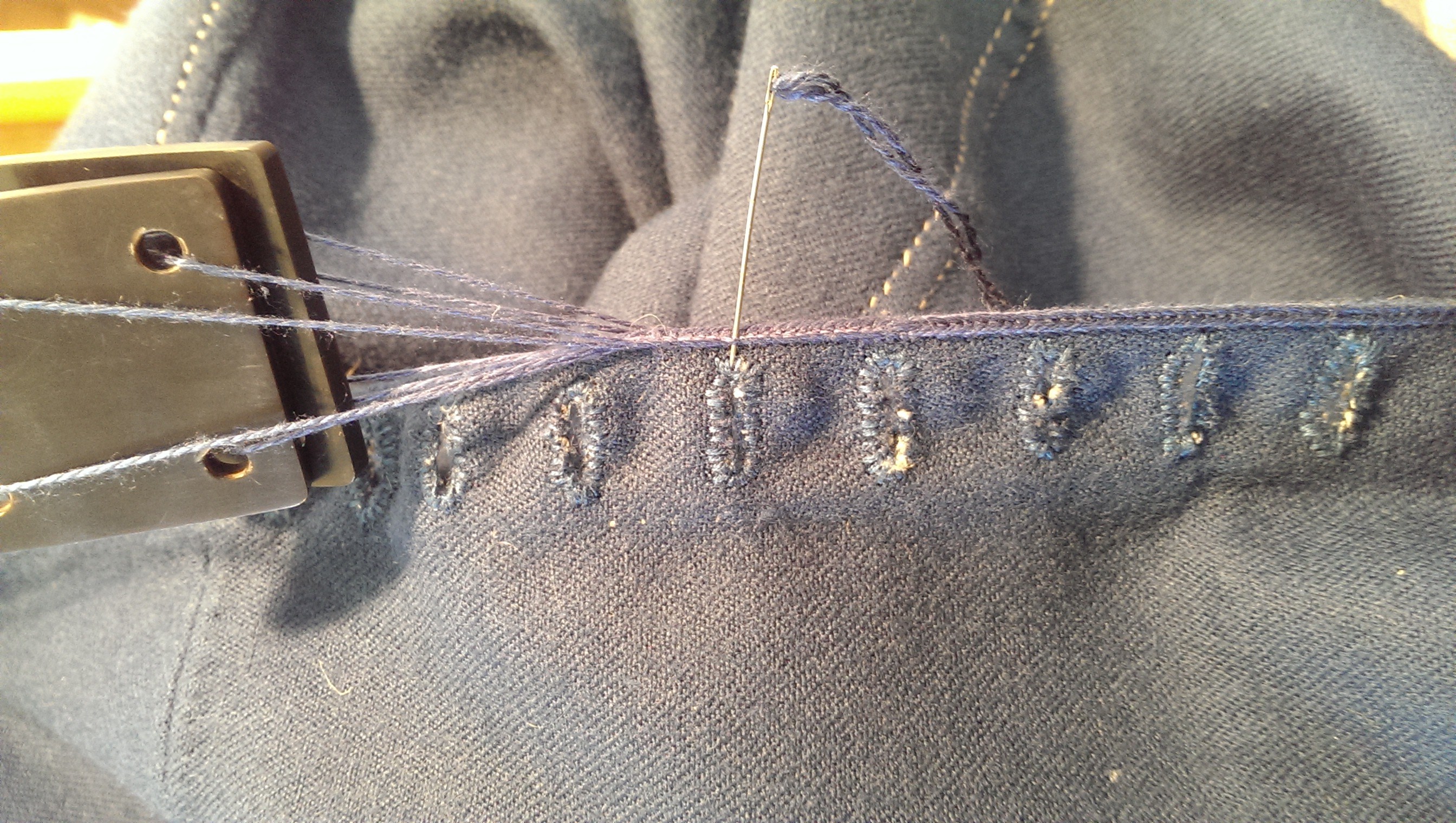
I had to insert a gore in the middle back to expand the fit over the hips. The first dagged edge was sacrificed. I cut it off so that I could add an extra piece of fabric, following the lines of the pattern and lengthening the whole garment about 25 cm. When that was done, I had to re-do the dagged edge, now wider. All this was about three extra days of work, re-doing things I knew I should have done from the start. In the end I had a kirtle that was a slight bit longer than I had planned in the first place, but it looked very much like my original picture.IMAG2278IMAG2279It is bitter and tedious work, mending up a mess you’ve made yourself. But once I got the length right, I celebrated my victory by turning my attention to things I actually enjoy doing: details like buttons, buttonholes and pretty edges. The thin woad blue twill was a dream to work with and I hand stitched everything with silk or waxed linnen thread.

IMAG2300IMAG2281

IMAG2286

Curvy cut over the chest and a pretty tablet woven edge in silk.

A strip of linnen lining the inside and a tablet woven edge on the outside strengthens the buttonhole edges. I used silk yarn in the same woad-blue for the weft and ended up with 63 buttonholes all in all. 10 in each sleeve and 43 down the front. The buttons themselves look like little blueberries…

IMAG2288

Slowly getting there, still a few more buttons to go…

The kirtle is deliberately cut with a light curve over the chest and has medium size “grand assiette”-sleeves with a gore inserted over the shoulder in the back. This allows for maximum freedom of movement in arms and shoulders but still gives a nice tight fit. I also added a small standing collar because I like how it looks. It doesn’t show on my manuscript-picture because of the hood, but low collars like this one are seen on other pictures in King Modus.

Egen1I finished the whole kit just in time for an event this past weekend. I’m so happy with how it turned out, but also surprised by the princely 10479940_10152625157110708_7587428764304000842_olook it gives me. The kirtle look so much more glamorous than I expected! But as I’ve worn and torn it during this weekends adventures, it starts to feel more like me.

Johan carved the horn that I carried with the rest of the outfit. I love how it is decorated with winding bands of wine leafs, happy hares and playful greyhounds. It has got a characteristic smell of tar, beeswax and gunpowder that I wouldn’t mind having as a personal signature scent.

I made a simple thin baldric for my horn but have already started to work on a larger and wider one to be more elaborately decorated, in the style of Livre de Chasse. (More on hunting horns is hopefully coming in a later post.)

10547855_10152625159630708_2827456825857376384_o

Photo: Annie Rosén

1973527_10152625158810708_4295313694744994988_o

Photo: Annie Rosén

So this is it for my first manuscript challenge. It was fun and intense to make the outfit, all hand stitched and with extreme attention to every detail. Slightly challenging to correct my mistakes by enlarging the pattern for the kirtle at such a late stage and lots of extra work, but not very difficult.

I find it stimulating to work towards a tight deadline with a very clear picture of where you are going, so the manuscript challenge suits me very well. But now when I’m done with it, I think I’ll want to start over again with a new picture of a hunter in another manuscript and go for something harder for my next attempt…

Rather close, don’t you think? If you like my work, please let me know. If you like the dog or her chain-mail collar more, do tell Johan who let me pose with her, and not me. 😉

1797515_10152160197582765_4688588845508775182_n20140827_163242_Richtone(HDR)/ Emil

  • Estimated time to make this hand sewn kirtle: + 80 h
  • Material needed: Blue twill wool, ca 1,70 meters, plus scraps of unbleached linnen. Sewing thread in silk and linnen, beeswax. The 63 buttons was made of leftover cloth. I had all the material at home when I started.
  • Total cost to make: ca 400 sek / 40 eur